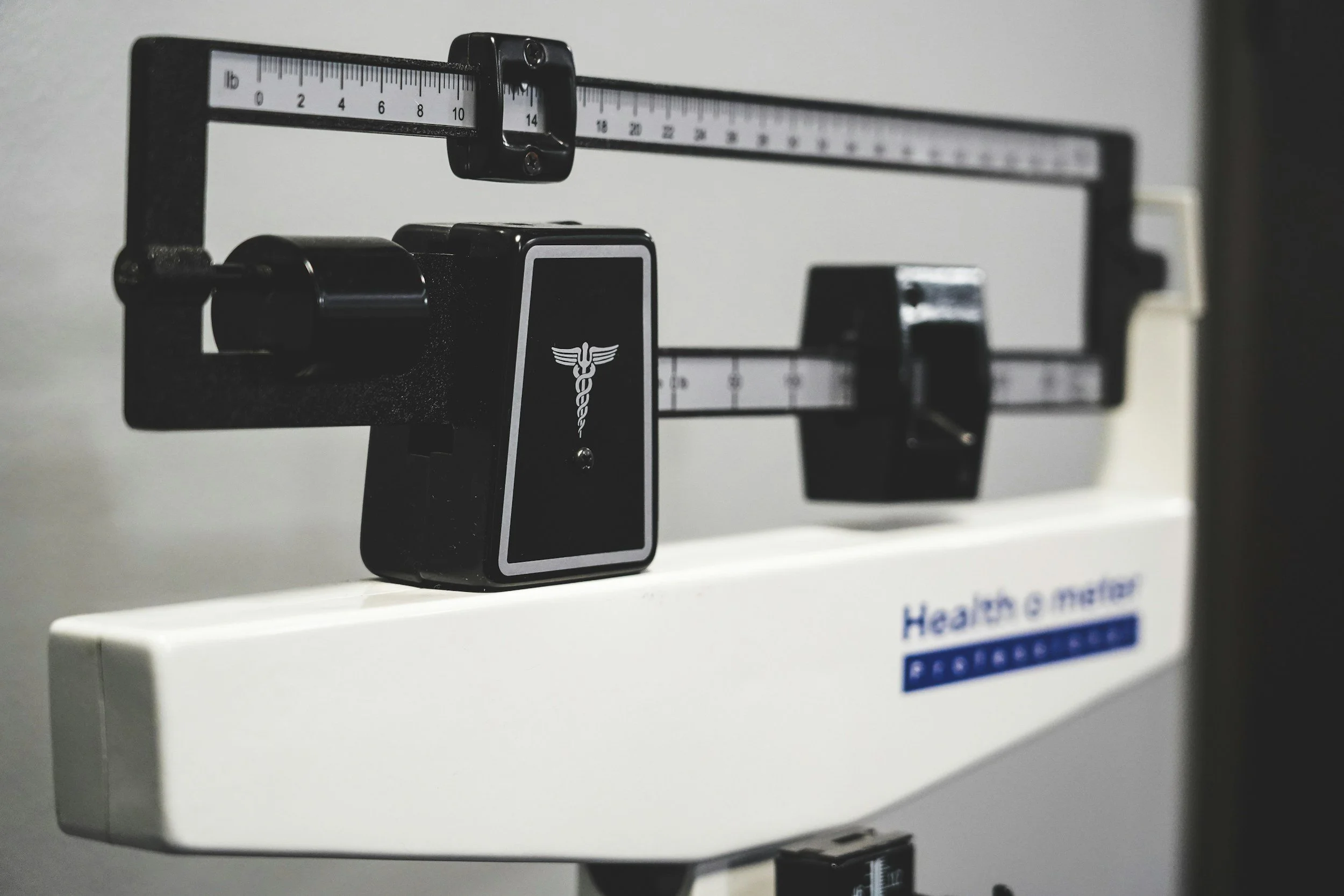
Weight is one piece of information. When it becomes the whole conversation, the things actually driving how you feel can go unexamined.
Most women have heard it at least once.
You come in tired, or your cycle has changed, or your blood sugar is creeping up. And the advice comes back to one thing: lose some weight.
Sometimes that's said kindly. Sometimes it isn't. Either way, it usually lands the same, as an outcome, with no plan attached.
Weight can matter for health. But "just lose weight" skips the most important question: what's actually going on?
Weight doesn't tell the whole story
Weight is easy to measure, so it often becomes the headline. But on its own, it's a blunt tool.
In a large national study, almost a quarter of normal-weight adults had two or more cardiometabolic risk factors, things like high blood pressure, high blood sugar, or unfavorable cholesterol. At the same time, about a third of adults in the obese category had none of those patterns clustering together rootedfunctionalmedicine.
That doesn't mean weight is irrelevant. It means weight alone can't tell you who is metabolically healthy and who isn't. Two women at the same weight can have very different pictures underneath.
Why “eat less, move more” so often stops working
Most women who've been told to lose weight have tried. Many have succeeded, at least for a while.
The pattern is familiar: early weight loss, then a plateau, then gradual regain onlinelibrary.wiley. That isn't a failure of willpower. It's a predictable biological response.
When you lose weight, your body adapts. In one study that followed contestants from an extreme weight-loss competition, their resting metabolism was still burning about 500 fewer calories a day than expected six years later, even though most had regained much of the weight rootedfunctionalmedicine.
That was an extreme program, and most people's experience is far less dramatic. But the direction is the same: the body works to defend its weight. Eating less and less isn't a sustainable answer to that.
This is why so many women feel like they're working harder for smaller results each time they try. They aren't imagining it. And it's why long-term care matters more than any single round of dieting, weight is something to manage thoughtfully over time, not a problem to solve once and forget onlinelibrary.wiley.
What it costs when weight is the whole conversation
There's another problem with "just lose weight." It can make women stop showing up.
Weight bias in healthcare is well documented. It can reduce the quality of care, and when people expect to be judged for their weight, they may avoid appointments or put off recommended screening onlinelibrary.wiley.
The pattern I see often: a woman who has quietly stopped bringing up her symptoms, because she already knows what she'll hear. By the time she does, she's been dealing with it for years.
What a real plan looks at instead
A plan starts with the why. Depending on the person, that might include:
Blood sugar and insulin. Insulin resistance can drive weight changes, cravings, and fatigue, and it can show up at any weight rootedfunctionalmedicine.
Hormones. Cycle changes, PCOS, thyroid function, and the shifts of perimenopause all affect metabolism.
Muscle. Muscle is one of the main places your body handles blood sugar. Very low-calorie dieting can make it harder to keep.
Sleep and stress. Both affect appetite, blood sugar, and how your body stores energy.
Nutrients and medications. Some deficiencies and some medications change energy, appetite, and weight.
This isn't a checklist to work through on your own. It's a reminder that weight is often the result of something else, and that something else deserves attention.
What actually moves the needle
Shift the goal from a number to a pattern. Energy, cycle, blood sugar, strength, sleep, these tell you more about how your body is doing than a scale alone.
Eat enough, especially protein. Chronic restriction tends to backfire. Steady, adequate meals support both muscle and blood sugar.
Build strength. It supports metabolism in a way that cutting calories can't.
Protect sleep. It's one of the most underrated metabolic tools there is.
Use medical tools when they fit. For some people, weight-loss medication is an appropriate and helpful part of care. The goal is a plan that fits you, not a single answer for everyone.
A note of caution: sudden, unexplained weight change, gain or loss, deserves a medical evaluation. Don't wait it out.
If you've been told to “just lose weight”
You deserve more than an outcome. You deserve a plan, one that starts with what's driving how you feel.
If that's what you're looking for, the Start Here form is the first step. It only takes a few minutes, and once it's in, you'll be able to schedule from there: Start Here.
— Miranda Rozecki, FNP-BC, IFMCP
References
Wildman RP, Muntner P, Reynolds K, et al. The obese without cardiometabolic risk factor clustering and the normal weight with cardiometabolic risk factor clustering: prevalence and correlates of 2 phenotypes among the US population (NHANES 1999–2004). Archives of Internal Medicine, 2008. https://pubmed.ncbi.nlm.nih.gov/18695075/
Fothergill E, Guo J, Howard L, et al. Persistent metabolic adaptation 6 years after "The Biggest Loser" competition. Obesity, 2016. https://onlinelibrary.wiley.com/doi/full/10.1002/oby.21538
Hall KD, Kahan S. Maintenance of lost weight and long-term management of obesity. Medical Clinics of North America, 2018. https://pubmed.ncbi.nlm.nih.gov/29156185/
Phelan SM, Burgess DJ, Yeazel MW, et al. Impact of weight bias and stigma on quality of care and outcomes for patients with obesity. Obesity Reviews, 2015. https://onlinelibrary.wiley.com/doi/abs/10.1111/obr.12266